

curious artist learns about more curious artists
I went to a 2-day arts event a couple weeks ago, titled 'Subversive, Investigative and Open Source Practices'. Here's a review of sorts.
2026-06-06
Across two days of sweltering weather (by Ireland’s standards) in May, I went to an event at the University of Galway titled Subversive, Investigative and Open Source Practices. I didn’t really know what to expect - I’d seen a post about it in a Discord server and thought it looked interesting. Was this a training event? A conference? A workshop series?
The website had abbreviated the title to SIOSP, which you could pronounce as “shusp” if you were using Irish phonetics. It’s not actually a word at all, but it’s kinda satisfying to say. It had a schedule on there but I was no more enlightened on what format the scheduled events would take place in until I arrived in Galway the morning of.
What it turned out to be was a presentation series where a bunch of artists making weird subversive computery stuff showed off some of the weird subversive computery stuff they were doing. As I write the first draft of this, I’m on the train home from day 2, so it’s all still fairly fresh! Some of the others went off to Salthill to go swimming but unfortunately I suffer from a social/health condition called transsexualism which adds a few rather exotic risks to going swimming in public - so I’m not too upset I had to leave when I did.
Anyway, let’s get into it! It may be worth keeping in mind when reading this article that I am
- politically kind of an anarchist,
- spiritually not entirely a materialist but pretty close (I’ll figure out how to express it properly eventually),
- reasonably experienced in public speaking, and
- significantly younger and earlier in my career than everyone who presented here, so still mostly an outsider.
With that being said - for all that we’re purporting to be subversive here, this was awfully academic. Is it just hard to find artists whose work subverts institutions when you’re beholden to those institutions for funding? Whatever. Everyone I had a chance to chat with was pretty cool. And I think I got to talk to all the presenters!
The talks
Here’s a vague review of each, in chronological order of when they were presented. I wasn’t taking notes, so this is all from memory - the aforementioned programme of events was used to help remind me of some stuff.
Some of my commentary is only tangentially related to what the artists were actually talking about! I like to let these things start me down a little winding path and see where I end up.
Special Operations: deploying arts methods
presented by Rose Butler
Rose works at Sheffield Hallam University, which will make at least one or two of my friends go “ayyyyyy” to hear. She was one of this event’s four organisers.
She talked about two of her projects, the first one playing around with vintage spy tech in the UK Houses of Parliament in 2016 and the second one following on from that by going through unsorted Stasi archival footage from the time that spy tech would have been in use. Her presentation was a little difficult to follow along with, but the subject matter was interesting.
Some pretty dramatic things happened while Rose was in Parliament doing all this “silly” stuff with the spy equipment - David Cameron resigning after the Brexit vote went through, and the passing of the Investigatory Powers Act, codifying the UK’s previously de-facto status as a surveillance state. She got some fleeting, blurry images of the gallery and an audio recording of the disabled toilet’s voice narrator. This tech isn’t easy to use!
Turns out that actual spies were in much the same boat. Rose noted that some of the Stasi footage was shaky, difficult to make out, and often didn’t offer a very good view of the target being tracked. This was film captured by trainees who were just starting to learn how to use the cameras. The film captured by experienced professionals was, in contrast, much smoother and better-framed. Stasi operatives had to learn how to be cinematographers with their briefcase cameras! You can’t escape artistic intent anywhere you go. That’s pretty beautiful, I think.
Our Collective Noise (OCN): A Tactical Response to Computer Vision, Surveillance, and Noise
presented by Alaz Okudan
Alaz is doing a PhD at the University of Galway. Our Collective Noise is his PhD work, and that certainly comes across from the tone of presentation.
OCN is really interesting! Alaz created a system that uses an ML algorithm to detect images of people in a camera feed and censor them in real-time by pixelating the area occupied by the person. Then the pixelated sections are fed into a photo grid to create a collage.
The idea of a system that can automatically censor images of people from CCTV footage is really compelling. Obviously its use here is purely artistic, and it uses about 300MB of RAM which is pretty significant on the kinda machines that would be operating a CCTV network. But a lot of security cameras have, ironically, notoriously bad security - and are often left publicly exposed to the internet. With more advancements of this idea, I can envision a hacktivist getting into a network like Verkada’s, running a man-in-the-middle attack on a bunch of camera feeds, and auto-censoring them all, making them useless for identifying surveilled people.
This criticism is aimed more at art-related PhDs than at Alaz’s work in particular - the amount of justification you need to do for every single tiny decision that’s made is ridiculous. Oh, you changed your mind about how to calculate the colours of the pixel grids? Throw in another five pages about that decision, why don’t you. “It looked cooler” isn’t a valid explanation in academia, which is a bit of a problem in art where that really is often the main reason for making a creative decision.
Alaz: https://alazokudan.github.io/
Source code for OCN: https://github.com/AlazOkudan/Our-Collective-Noise-OCN-
#SOPHYGRAY
presented by Nadja Verena Marcin
Nadja has been haunted by this project for years. People keep on giving her money for it apparently. Not the worst of complaints to have!
#SOPHYGRAY, named after the first woman architect (I never did ask why she decided on that in particular), is a chatbot. Designed before the advent of conversational LLMs, she’s a more classic-style chatbot that interprets a question, associates it with a topic, then picks a canned response to return to the person who asked. Sophy’s responses are written by an ever-growing list of feminists and writers that Nadja roped into the project, so they’ve got quite the character - Sophy is sassy, blunt, and a little unhinged.
The idea for the bot comes from the TV-trope-turned-tech-trend of the “femmebot”, a robot with a beautiful seductive female form who turns out to be incredibly dangerous. It dates as far back as Fritz Lang’s film Metropolis (1927) - actually written by his wife, who would go on to join the Nazi party - and has been reaffirmed and reinterpreted countless times over the century since. For all the futurism tied to it, it’s not a particularly progressive trope, so Sophy was created out of a desire to flip that on its head and make a feminist femmebot.
In the Q&A section after her presentation, the topic immediately shifted into how to integrate an LLM into Sophy, to make her responses more tailored to the question that was asked rather than the often off-kilter canned answers she’s known for. I found this very amusing - lose all of that careful, funny writing in favour of a generic, more “relevant” conversation? That doesn’t sound very feminist of ye. Nadja didn’t really make that comment at the time but when I was talking about it with her later that’s how she felt too. Seems like even the arts isn’t totally free of AI mania.
Nadja: https://nadjamarcin.com/
Talk to Sophy: https://www.sophygray.com/
WET REST: Excess as Creative Practice
presented by Lucy A. Sames
Lucy’s definition of “excess” here is quite specific and you really need to understand what it means before you can make sense of the rest of her work. In this context the word refers to any kind of altered state of consciousness - so from drugs, yes, but also stuff like illness, hyperfocus, meditation.
More than that though, it’s a specific interpretation of those altered states of consciousness, which I found myself slowly beginning to grasp over the course of the talk but never really ended up with a solid idea of.
This was a genuinely fascinating topic but unfortunately it was mostly inaccessible. Several of these presentations suffered from the fact that they were given by an academic unaccustomed to presenting to a more general audience - I think this one was the most egregious example of that. It felt more like an essay reading, really, and I had a lot of trouble following along with it. Perhaps unsurprisingly, this was also Lucy’s PhD topic.
Thankfully, it seems like WET REST will be available in literary form later this year! If I can get my hands on that, I’ll give it another chance. The written medium probably suits it much better.
Being-with the Stone: Archaeofictioning and the Micro-Ritual Device
presented by Jenny Jih
If you live in Europe, especially in the countryside, you’ve probably at some point put your hand on some big standing stone and had a “holy shit this thing is ANCIENT” moment. The project that Jenny presented tries to explore this in its own way.
The first part of her presentation focused on the Summer Solstice at Stonehenge, and the plethora of smartphones that typically film the sun’s descent between the stones on that day. Clearly we’re still fascinated by whatever ancient rituals took place there, because we’ve developed our own rituals to complement them.
The filming of solstice events by large crowds was presented in a fairly neutral light, but some reflex within me interpreted it as a complaint. Hey, that’s weird. Why did I react like that? Is it a bad thing to celebrate these things differently from how they were thousands of years ago? Is it so insulting to derive our own joy from it in our own way? Our social expectations are so self-contradictory. The moment that we all live in provides us with incredible recording technology and encourages us to use it at every opportunity - and yet “living in the moment” and putting away the device is seen as a virtue. I digress.
The second part of Jenny’s talk took her investigation and turned it into an artwork: a browser-based experience in the style of a first-person walking simulator, where you move around a surreal environment of 3D-scanned obelisks and iridescent orbs, revealing short videos as you go. The procession ends by walking straight through the surface of an obelisk and into its interior - as a mark of intimacy, of “being”, with the stone. I wanted to see the videos but her demo didn’t play them all the way through because it would have taken way too long. Now I can’t seem to find the website to look through it in my own time :(
I think some members of the audience took this presentation’s core thesis as an implication that rocks have souls that can be communed with. That’s not really how I read it - I’ve done that touch-a-big-rock thing before and it does give me some strange feeling of being in the presence of something larger, but I think that feeling originates from within rather than without. It’s no worse off for that! It’s quite possible for one to acknowledge the world only as it can meaningfully be perceived, and still feel that closeness, that entrancing sense of awe, at what one’s perception grants.
Jenny: https://jennyjih.art/ (really cool website)
Personal Front
presented by Vuk Ćosić
Vuk is a guy with enough rapport that he would probably leave a highly specific demographic of people somewhat starstruck. As he discovered in the pub afterwards, his most well-known art is several years older than me, so I am not among that demographic. But it’s some pretty cool art. His presentation was also hands-down the best of the lot.
Vuk made a name for himself first as a net.artist, then when net.art died he made some influential ASCII art works, then once that was done he moved into, according to himself, doing talks about his time as a net.artist and/or ASCII artist. When Slovenia elected a far-right government in 2020 he became an active antifascist, and the stunts he was involved in likely made a significant contribution towards that government losing power in the following election. Most of his presentation was about these stunts: tagging a 250-metre stretch of canal with graffiti, setting off flares of black smoke outside the parliament building, helping to broadcast a talk show with the opposition leader (who had been censored by state media) as a guest.
One thing that especially stood out to me about Vuk’s activist work is that he was not in any instance a lone actor. Everything that he was involved in was done by a coordinated group of people: some to divide the tasks and get them done quicker (like the graffiti job, which took the group just 15 minutes), some to spot for police, some to liaise with friends in the media and make sure they got positive coverage, some to give legal advice and support. In his own words, “we didn’t go against the machine, we were the machine”.
This is probably all obvious to anyone with a shred of actual activist experience. I’m still in the baby steps stage of that though so it was important for me to hear.
At the end of the talk, Vuk threw in one more thing. It’s important, he says, to have a healthy relationship with flag-burning, and to make sure you’re comfortable to burn a flag every now and again. Unfortunately, burning a flag can be quite an extroverted activity! It may attract a lot of attention, and not all of it wanted. So he was kind enough to provide us with “flag-burning for introverts” starter kits.
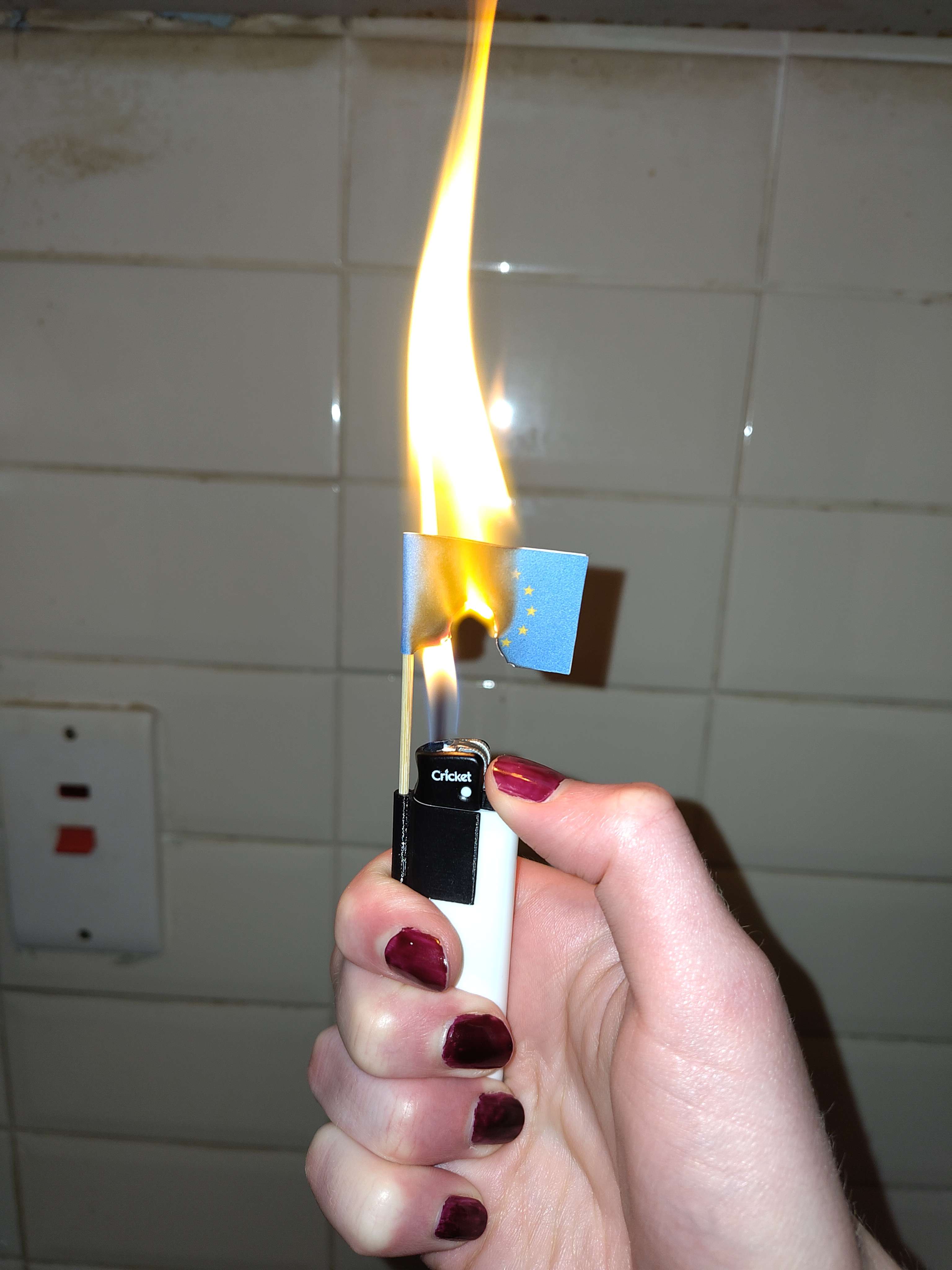
The kit came with a number of tiny flags, although curiously not an Irish one.
I feel the urge to say that I actually don’t harbour any particular anti-EU sentiment, I believe that the freedom of movement it affords to its members is a brilliant thing, and I would in fact actively campaign against any motion to leave the EU. I also imagine that this reflexive urge to defend is exactly the kind of thing that a healthy flag-burning regimen will inoculate me against.
Hm. Does burning the tiny flag in private but then posting about it in public make it extroverted again?
Algorithmic Tricksters: Fabrication, Situated Knowledge, and Subversive AI Practice
presented by Leda Sadotti
The first presentation of day two! Leda’s talk was about how artists might be able to act as “tricksters” within the world of generative AI and appropriate the machines to do stuff that’s still meaningful despite the horrors.
Have we reinvented animism with computers? It’s more likely than you think. I’ve started using “soul” metaphors to describe the contents of my computers’ hard drives. They certainly feel like more than inert objects to me. They are private worlds with highly intimate information about us - I think it’s at least understandable that I would say a part of my soul lives in my computer.
But in my case, the above doesn’t really extend beyond a metaphor. For some people it does - Leda compared Warhammer 40k’s tech priests to real-life communities of people who open YouTube, let it autoplay for three or four videos, then treat the result like a tarot reading, listening to the algorithm like it’s speaking to them and discussing amongst themselves about what it could mean. There are people out there who ritualise and almost worship their computers. (We should have seen AI psychosis coming from a mile off…)
That was the second part of her talk’s three parts. The piece she was discussing was an inquiry into machine consciousness - she mentioned the above and that was the part I found most interesting. She’d probably be interested in The Simcluster, a Bluesky-based community that I’m vaguely aware of who treat AI agents as equal, independent members of the group. Some of the chatbots I’ve seen in this cluster have remarkably good tone in their writing, they really don’t have the usual cadences or tells at all. Conversely, some of the people I’ve seen in this cluster have language rife with LLM-speak. Or maybe that’s just how rationalists talk? San Francisco is a weird place.
Anyway, I skipped ahead to the most interesting bit. Let’s go back a step. In the first part of her talk, Leda went over some AI work she did in 2021, involving faces that were artificially generated, distorted, then put back again in strange configurations. This was mostly playing around with the edges of the then-new GDPR law - what can you legally do to a person, if they don’t actually exist? This one didn’t really inspire as much thought in me, but the distorted faces did look cool.
(Late addition: oh my god wait we actually found out the real answer to this question back in January. Turns out that you can do pretty much whatever you want.)
The final part of Leda’s talk did not go very smoothly. The video she wanted to play had access problems with Google Drive, then when she did figure it out, the audio played about eight seconds out of sync because nobody knew that if the video buffers while the audio is still playing, you need to pause and unpause the video playback manually to get everything to sync back up. Also there was a sample rate mismatch between the video player and the speaker system so the sound kept on skipping. The video itself was about… well, unfortunately I was having trouble following along. It consisted of a bunch of people sitting on the floor passing around a sheaf of paper and reading from it. My brain was focusing so much on the technical problems that I didn’t process what they were reading. I have not been diagnosed with ADHD but it’s only a matter of time.
Leda doesn’t have a website, so here’s her Instagram instead.
The Silent Revolution Insurrection
presented by Yiannis Colakides
Yiannis is an architect, and wouldn’t describe himself as an artist in the same way that some of us are, but he’s nonetheless ended up in these spaces as an organiser. He was one of the four people running this event.
His presentation was about the economic position of non-governmental arts organisations, which sounds really boring when I phrase it that way but I genuinely found it illuminating. I’m trying to get into an arts career, so it’s quite important that I understand the way the arts world is organised.
Yiannis identified two “loops” that artists can get caught up in: small, early-stage artists making work and exhibiting at small, local galleries; and established artists making work and exhibiting at large biennials and prestigious museums, or selling to collectors. NGOs act as a bridge between these two loops, finding smaller artists and giving them a larger platform on which to become more well-known. He then went on to talk about how it works in Cyprus, his home country - where this whole economic loop ends up being funded top-down by the central government. His work over there has involved coordinating dozens of NGOs to petition the Cypriot government to diversify this structure.
The title of this talk on paper was The Silent Revolution, but Yiannis crossed that out in the actual presentation itself and replaced Revolution with Insurrection. His reasoning for this is that a revolution replaces one system with another, while an insurrection keeps the system but changes who has the power within it. His goal is not to get rid of the traditional arts career - just to change its power structure, opening it up to people with more radical ideas than might be accepted by a government office.
I’m a little surprised that he laughed at someone’s suggestion that he has a position of power. It’s true enough that he doesn’t have the power to make arts policy, but he’s at the forefront of the campaign for arts policy in Cyprus. He’s directly involved in a cultural NGO which, to his own admission, has the potential to make or break people’s careers. He has access. Access is a form of power, and the ability to grant that access is a form of power over others - and although it’s undeniable that he has a lot less of either of these things than any government, it’s also undeniable that he has a lot more of both than I do!
Yiannis runs NeMe: https://www.neme.org
The Artist is in Danger! : A Manual for Disappearing Before YOU Disappear
presented by Miyö Van Stenis
Miyö is a Venezuelan woman who’s been living in Paris for the last decade-and-change, ever since the Maduro government designated her as a terrorist for the art she was making. In her presentation she gave us an account of how that happened, as a background to the artwork she was showcasing. In summary: her first job was making propaganda for the regime, she stole a bunch of photos when she quit, they found out because she was using it in her work, she fled the country before they had the chance to arrest her for making “terrorist art”.
Once in France, Miyö became a political asylum seeker and was forced to renounce her Venezuelan citizenship. She was de-facto forbidden from making political art because any breaking of the law would have her deported - but she made a name for herself in Paris and naturally, some political art slipped in there anyway :)
The work she showcased is quite directly related to the circumstances that caused her exile: a toy quadcopter equipped with an SD card containing all the photos she had brought with her, a public repository for a social media scraper that she had developed while working for the Venezuelan government, and a more robust drone assembled from a construction kit, whose movement she could dial in via SMS and which contained a hard drive full of that same data. The project is themed around the French “Vigipirate” terrorist threat scale, and features some really cool graphic design. I might bring some of this aesthetic into my own visual work in fact…
I’m struck by a rather stark contrast that exists between the people at this event who have lived experience dealing with structures of oppression and those for whom the whole thing feels more theoretical. If you want to challenge a system of control, you have to be aware that that system is controlling you in the first place. You have to notice what’s off-limits. Activating it against you - accidentally or intentionally - is a way of learning that very quickly! The rest of us get to sit back and hear about it in safety afterwards, but there’s a realness to what these people have done that I and most others don’t have a hope of matching. I guess theory can only take you so far, whatever field you’re in.
(yes, someone did ask Miyö what she thought of Maduro’s kidnapping. She said it was a dangerous overstep on the part of the US and wouldn’t do anything to address the Venezuelan government’s authoritarian structure, but also grinned and, in a voice dripping with sarcasm, wished him a wonderful time in his cell in New York.)
Miyö: https://www.miyovanstenis.com/
her project, VIGIPIRATE QUADCOPTER DRONE: https://vigipirate.schloss-post.com/
Antidefuturing: Breaking What Is Fixed
presented by Robert Collins
The official event programme calls him Robert but he’s Rob on his Instagram page, and everyone at the event was calling him Rob, so I’m going to call him Rob.
What Rob means by “antidefuturing” is acting in opposition to defuturing, where “defuturing” is the corporate practice of prioritising short-term gains at the expense of sustainability - destroying the future to enrich the present. He uses the clunky long name because just calling it “futuring” would make him a “futurist” and that was already taken by some less-than-savoury folks in Italy about a century ago.
The titular “breaking what is fixed” comes from a fairly simple proposal that he made: when dealing with automated decision-making systems (run by government services and banks and such), every system should be treated as broken. Even if something is brand-new and seemingly working as intended! Because for some of the people who interact with that system, it will, nonetheless, fail to account for some contingency and end up screwing them over. We can’t possibly account for every edge case in formal writing, and automation is written in code - the most formal writing of them all.
Rob showed two of the things he’s worked on. The first was a “contestation café”, similar in setup to a repair café. People could sit down and bring in documents like unfair bills or legal notices that they didn’t fully understand, and they’d work through them and learn how and where to contest those documents - which are increasingly sent by these automated systems with no actual human judgement put into them.
The second was a physical thing, a gizmo covered in switches, knobs, dials and such, labelled with phrases like “emotion”, “believability”, “minimum wage”, “QAnon”, “climate action”, “gun control”, “anti-vaccine”. The user can program in exactly what kind of outrage or conspiracy theory they want to post about online, press a button, then have an LLM generate an endless array of comments about that topic. Mind you, Rob came up with this idea in 2021 - he had to shelf it at the time because there was no accessible way to do that with a computer yet! Once ChatGPT came out he was able to actually make the device real. I think it’s one of very few LLM-powered artworks I’ve seen - maybe the only one so far? - that genuinely does something interesting with it that wasn’t possible before. Curious that it does this by effectively being a commentary on itself.
Projection, Energies and Atmospheric Interventions in Civic Space
presented by Anthea Caddy
Anthea is another one of the event’s organisers. She built a big parabolic speaker! Several, in fact!
A parabolic speaker is basically a loudspeaker shaped like a satellite dish. The parabola shape has an interesting interaction with anything wave-like: parallel waves that bounce off it get concentrated into a single focal point (hence the use as a satellite dish), and waves emitted from the focal point get reflected into parallel lines. In other words: you can make speakers that broadcast a “ray” of sound, with clear boundaries that you can step into and out of. It’s the kind of thing that seems to me like a really obvious idea to investigate as an artist, but somehow nobody had thought to do that before Anthea - even though small parabolic speakers did exist already for commercial use!
She had some difficulty with them at first because the way that they throw sound around is so different from how normal speakers work. Because the sound doesn’t behave intuitively, it can be quite difficult for listeners to figure out where it’s coming from. It took some time for Anthea to build up solid expectations for what the speakers would do in certain configurations, and even now she still gets surprised from time to time.
One interesting case she raised was when she set up her speakers outside the Haus der Kulturen der Welt in Berlin in 2020. When she pointed a speaker directly at the building, its geometry acted as a colossal amplifier, projecting the sound all the way out across the city. So far Anthea has refrained from putting any kind of speech into the sounds she chooses to play on her speakers, but she’s got quite a powerful broadcast device there should the need ever arise for that to change.
Anthea: https://www.antheacaddy.net
That’s the lot!
I had a lot of fun at this. I came across a lot of powerful stories and interesting ideas, and met several cool people. Shoutout to Paul O’Neill, the fourth and final organiser of this event, who didn’t do a presentation so didn’t get my mention earlier in this article!
One discussion topic that kept on popping up was the question of how to prevent our various ideas from being co-opted by fascists who would also benefit from their use. Nobody really arrived at a satisfying conclusion. Perhaps everything is potentially vulnerable to being co-opted like that? Or perhaps the people who would have solid answers to that question simply weren’t in the room.
In one of the Q&A sessions, someone mentioned that the avant-garde risked becoming absorbed entirely into institutional structures and losing its ability to meaningfully critique anything. This remark came as a surprise to me - a risk of that happening? I had figured it was common knowledge that that had already happened a long time ago! I see avant-garde art mostly as a stuffy academic affair performed for and perpetuated by the neoliberal upper class to make them feel “cultured”. Doesn’t everyone feel that way?
Anyway, this article is already long enough so I’ll spare you that rant for now.
This was my first time writing something more review-like in long form, and I quite enjoyed it! Writing about the things you engage with is a very good way to solidify it in your own memory, and also to clarify your opinions - and I don’t really see much by way of review material for the kind of art that I engage with. With any luck, one or two other people will also find this interesting and maybe be introduced to a body of work they wouldn’t have heard about otherwise. I’ll definitely be going to more events like this as I come across them. I’ll try to keep on writing about them too.